

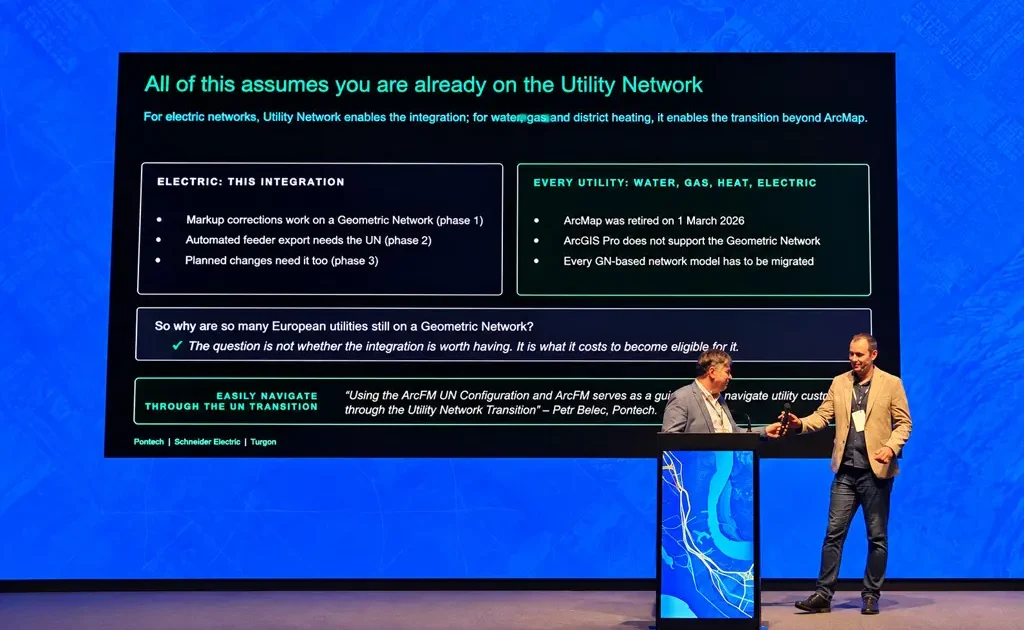
At the ESRI Romania User Conference 2026, Pontech, Schneider Electric and Turgon showed how the move to the ArcGIS Utility Network can shrink from a capital project of its own to a routine work package inside GIS modernisation.
In a joint session in Bucharest on September 29, Josip Aleksic, Digital Grid Sales Head CEE at Schneider Electric, and Catalin Vladutu, Country Manager of Pontech Romania, presented a complete route to modern network operations. Part one covered the productized integration between ArcFM and ADMS. Part two covered how a utility gets its data onto the Utility Network in the first place, and what an agentic, AI-assisted approach changes about that.
Why the Utility Network matters to every utility now
For electric utilities, the Utility Network is the entry ticket to Schneider Electric’s out-of-the-box ArcFM and ADMS integration. Markup corrections work on a Geometric Network, but automated feeder export and planned changes need the Utility Network.
For every utility, whether it distributes electricity, water, gas or heat, there is a harder fact. ArcMap was retired on 1 March 2026 (with extended support period through March 2028 specifically for utility customers), and ArcGIS Pro does not support the Geometric Network. Every network model built on one has to be migrated.
So why are so many European utilities still on a Geometric Network?
Not because anyone disagrees with the architecture. It’s because the migration has traditionally been a capital project of its own.
What a migration really costs
The actual data migration was 5% of the effort in Pontech’s Utility Network migration for DEO, the electricity distributor in Oltenia, Romania.
Half of the effort went to data cleansing: geometry corrections, attribute normalisation and connectivity fixes. Utility Network modelling took 20%, migration testing 15% and integrations 10%.
Around 40 Geometric Network feature classes became around 300 Utility Network asset types. Pontech ran 20 iterative test migrations over two years, with no operational downtime.
None of this is specific to electricity: the cost comes from the data, not the network type.
Same method, far less manual effort
Iterative migration is the approach Esri recommends, and the one Pontech followed at DEO: map, load, validate, review, refine, and repeat. Early cycles expose data problems; later ones expose model problems. The method is right.
The cost sits inside each cycle, in the hours experts spend reviewing results and deciding fixes by hand, asset type by asset type. That work scales with scarce expert time, not with budget.
This is where Turgon, the Schneider-backed agentic migration platform, comes in. Its agents profile the source data, propose the mapping to Utility Network asset groups, asset types and fields, and score their confidence on every proposal. Pontech’s experts then approve the confident proposals and work through the uncertain ones before anything is loaded.
The agents do not replace the expert. They move the expert from building the mapping to approving it.
Tested against a real delivery
The agentic approach reached the same accepted result as Pontech’s DEO delivery in about 8 to 12 weeks, against 6 to 15 months for the standard approach.
Rather than a demo on a clean sample, Turgon’s agents worked on real data: a balanced medium-voltage network with ring topology and normally-open points. They received the source data and the target schema, but not Pontech’s mapping or migrated result. Both approaches were then judged on the accepted end state, not on the route taken.
One limit remains: no model can detect data that is wrong in the field. Physical verification is still essential.
What it means for utilities
The migration stops being a programme of its own and becomes a work package inside modernisation, with first improvements in three to six months.
Until now, it needed its own business case, its own board approval, and 12 to 24 months before anything improved. ArcFM, ADMS, and every other Core Distribution System waited behind it.
With an agentic approach, the migration is budgeted as a line and operational systems roll out in parallel.
“Using the ArcFM UN Configuration and ArcFM serves as a lighthouse to navigate utility customers through the Utility Network Transition,” said Petr Belec of Pontech.
“Every utility we speak to agrees the Utility Network is where they need to be. What held them back was the cost of getting there. Our work with Turgon shows the migration no longer has to be a programme of its own,” said Catalin Vladutu, Country Manager of Pontech Romania.
About the partners
Schneider Electric builds the platform. Turgon accelerates the migration. Pontech deploys.
> Schneider Electric provides EcoStruxure ArcFM on the Utility Network for electric, gas and water networks, and EcoStruxure ADMS for electric distribution.
> Turgon provides the Schneider-backed agentic platform that accelerates the migration to the Utility Network.
> Pontech is a GIS systems integrator for utilities, an Esri partner and a Schneider Electric EcoXpert partner for ArcFM. It deploys the migration, ArcFM, and carries accountability for what goes live.
Planning your move to the Utility Network?
Contact PONTECH to discuss what the migration would take for your network.